
Results from ProTarget presented at ESMO 2026
On Friday 23rd of October we presented new results from two separate cohorts in ProTarget. The results were presented at the ESMO conference in Madrid, Spain, and may help refine patient selection for BRAF/MEK-inhibitors and PARP-inhibitors, respectively, beyond current European Medicines Agency (EMA)-approved drug labels.
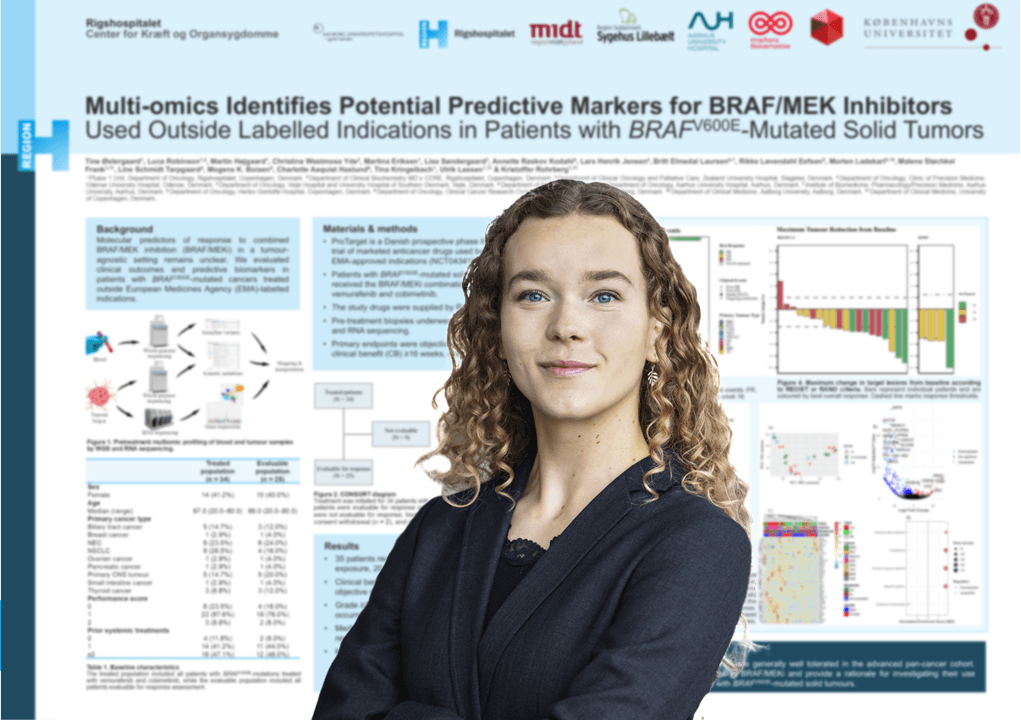
Multi-omics identifies tumor-agnostic predictive markers that may improve patient-selection for BRAF/MEK inhibiters
Tine Østergaard, MD student, presented findings from the ProTarget trial investigating clinical outcomes and potential biomarkers associated with response to off-label BRAF/MEK inhibition in patients with BRAFV600E-mutated solid tumours.
While combined BRAF/MEK inhibition has demonstrated clinical efficacy across several BRAFV600E-mutated cancers, predictors of response remain poorly understood, particularly in a tumor-agnostic setting. To address this challenge, the study evaluated clinical outcomes and baseline molecular characteristics in patients treated with BRAF and MEK inhibitors outside EMA-labelled indications.
The potential role of baseline biomarkers was explored by integrating whole-genome sequencing and RNA sequencing data from pretreatment tumor biopsies with clinical outcomes. The analyses suggested that TP53 alterations and immune-inactive tumor microenvironments may be associated with response to BRAF/MEK inhibition.
The work was conducted as part of the European PRIME-ROSE consortium, which brings together DRUP-like clinical trials across Europe to strengthen evidence generation for precision oncology treatments.
The results support the continued development of molecularly guided treatment strategies and demonstrate how integrated multi-omic profiling may improve our understanding of treatment response across tumor types.
New results on PARP inhibitor efficacy and safety beyond current drug label
In parallel, Tina Kringelbach, M.Sc., Ph.D., presented new results on the efficacy and safety of niraparib, a PARP inhibitor, beyond its current indication.
The study included 60 patients with 20 different cancer types who were treated across eight Danish clinical sites. Niraparib showed limited efficacy in this heavily pre-treated cohort of patients with advanced solid tumors. The treatment was generally well tolerated, although serious treatment-related adverse events, including one suspected unexpected, serious adverse reaction (SUSAR), were observed.
Patients were eligible for treatment if they had somatic or germline inactivating mutations in BRCA1/2, ATM, ATR or exhibited HRD on a tumor-derived sample. Patients with ovarian or prostate cancer were excluded from participation.
These results suggest that treatment benefit may vary across actionable genomic alterations and highlight the importance of collecting high-quality data on off-label targeted therapies. Next step will be to perform comprehensive multi-omic analyses to gain further insight in genomic features that may predict clinical benefit to PARP-inhibition across tumor types.
These projects were conducted through a collaboration between the Phase 1 Unit and Department of Clinical Biochemistry, MDxCORE, at Rigshospitalet and academic and clinical partners across Denmark, including Aalborg University Hospital, Aarhus University Hospital, Vejle Hospital, Herlev and Gentofte Hospital, Zealand University Hospital, Odense University Hospital, and Region Hospital Goedstrup.
Through prospective collection of comprehensive data on treatment efficacy, biomarkers and safety, ProTarget continues to build evidence to support more informed treatment decisions and improve patient selection for precision cancer medicine beyond current drug indications.